Recover the leads
you're already paying for.
Guides on partial lead capture, form-abandonment recovery, AI lead qualification, and ad attribution from PartialLeads.
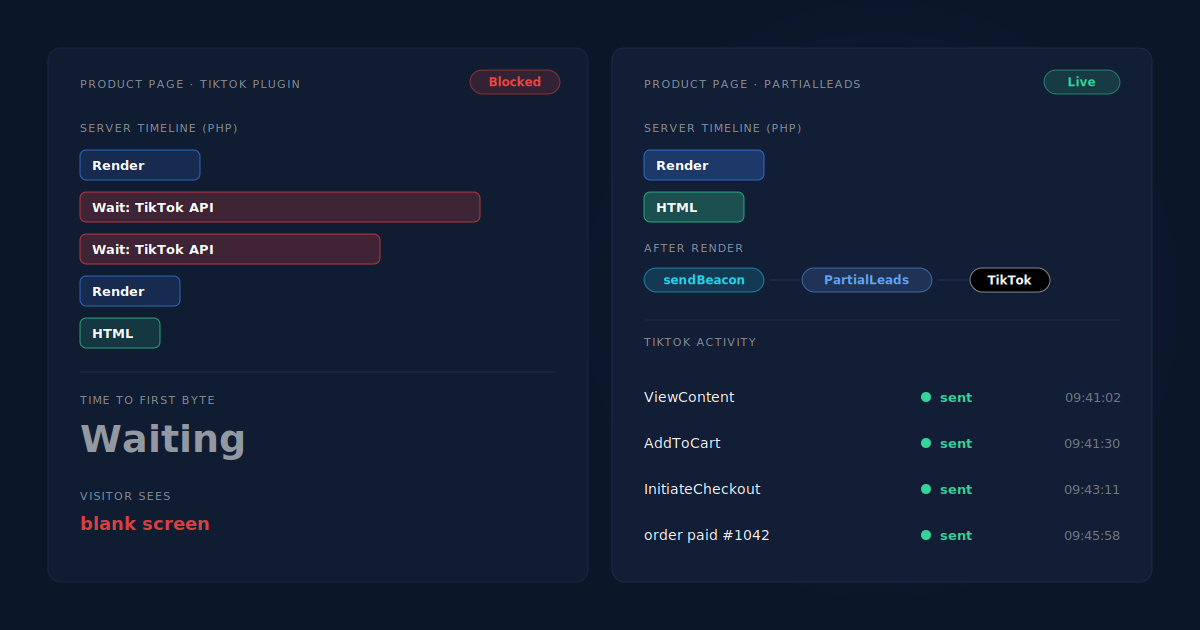
Why Is TikTok for WooCommerce Slowing Down My Store?
Product pages that used to load instantly now hang for seconds, and the slowdown started when you connected TikTok. The cause is usually not the pixel in the browser but the plugin calling TikTok's Events API from your server while the page is still being built. Here's how to prove it in ten minutes and how to keep server-side TikTok events without paying for them in page speed.
More articles
Why Doesn't the Meta Pixel Fire on Elementor-Built WooCommerce Product Pages?
Your pixel fires on the home page and the category grid, then goes quiet the moment a shopper opens a product built with an Elementor template. It's rarely the pixel. It's a WooCommerce hook your template never calls. Here's how to confirm it in five minutes and the fixes that survive the next theme update.
Tracking & AttributionWhy Does Shopify Show "pangleglobal" Instead of Your TikTok UTMs?
You tagged every TikTok ad, and Shopify still files the sales under "pangleglobal". That label is TikTok's app network, not a mystery source. Here's why your UTMs didn't make it, how to check, and how to tell which campaign actually sold.
Tracking & AttributionWhy Does Pinterest for WooCommerce Send Four AddToCart Events for One Cart Addition?
You add one product to the cart and Pinterest's event history shows four AddToCart events. The cause isn't your theme or Pinterest. It's a WordPress hook that fires for carts your shopper never touched. Here's why it happens, what the 1.5.1 update fixed, and how to keep exactly one AddToCart per add.
Tracking & AttributionHow Do You Track Meta Conversions on a Shopify Hydrogen Storefront?
On Hydrogen, the ad click lands on your React storefront and the order happens on Shopify's checkout domain. Meta sees two strangers. Here's where the join breaks and how to put the Purchase back on the right click.
Tracking & AttributionDoes Your WooCommerce Tracking Plugin Work With HPOS?
WooCommerce keeps nudging you to switch on High-Performance Order Storage, and you can't tell whether your pixel or tracking plugin will still see orders afterwards. Here is how WooCommerce decides what's compatible, which kind of tracking code actually breaks, and the ten-minute test that tells you before your purchase numbers do.
Tracking & AttributionWhy Isn't the AddToCart Event Firing on My WooCommerce Shop Pages?
AddToCart shows up when shoppers add from a product page, but the shop grid and category pages are silent. That's WooCommerce's AJAX add to cart doing its job: no page reload, so your pixel never notices. Here's what's actually happening, a five-minute test to prove it, and the fixes that make every add count.
Tracking & AttributionWhy Isn't Meta's CAPI Purchase Firing for Instagram In-App Buyers on iPhone?
A shopper taps your Instagram ad on their iPhone, adds to cart inside Instagram, approves the payment in their bank or PayPal app, and lands back in Safari. The order is real. Meta never hears about it, or hears about it with no click attached. Here's what the two browsers do to your Purchase event, and how to send it from the order instead of the page.
Tracking & AttributionWhy Does the TikTok Pixel Throw "ttq is not defined" on WooCommerce?
Your console says "Uncaught ReferenceError: ttq is not defined" and TikTok's purchase count is lower than your orders. That error isn't cosmetic: every event snippet that hits it is dropped. Here's why the TikTok pixel's event code runs before its base on WooCommerce, how to find which plugin reordered it, and how to send events that don't depend on ttq at all.
Tracking & AttributionWhy Does My WooCommerce Conversion Value Lose Its Decimal Places?
Your store says €49,90. Meta says 49. Google says 4990. Nobody is lying: a comma decimal separator is being read by code that expects a dot. Here's how each wrong number is produced, how to spot which one you have in five minutes, and how to send the total straight from the WooCommerce order so formatting never touches it.
Tracking & AttributionWhy Does My Shopify Custom Pixel Send the Sandbox URL Instead of the Real Page?
Your custom pixel is reporting a page nobody visited, and your UTMs vanished with it. Shopify runs custom pixels in a sandbox, and every tag that reads the browser's address reads the sandbox's. Here's where the real URL lives and how to send it.
Tracking & AttributionWhy Does Microsoft Ads Say "A UET Event Was Fired From Within an IFrame" on Shopify?
You moved your Bing UET code into Shopify Customer Events, and now UET Tag Helper says the tag fired inside an iframe and msclkid never shows up. The warning is accurate: that is exactly where Shopify runs custom pixels. Here is what the sandbox hides from UET, what still works, and how to get Shopify sales back to Microsoft Ads without depending on the iframe.
Tracking & AttributionWhy Does Microsoft Ads Record the Same Revenue for Every Shopify Order?
Every Shopify sale lands in Microsoft Ads at the same flat amount, whether the cart was $19 or $900. That is not Microsoft averaging your orders. It is a fixed number coming from the goal or from a tag that never read the order. Here is how to tell which, and how to get each order's real value into Microsoft Ads.
Tracking & AttributionWhy Does Meta Receive Duplicate AddToCart Events From My WooCommerce Store?
Every cart addition on your WooCommerce store shows up twice in Events Manager. It's almost never Meta's fault: two tools are reporting the same click, or one tool is hearing it twice. Here's how to tell which, a ten-minute test to prove it, and the fix that leaves exactly one AddToCart per add.
Tracking & AttributionWhy Does Google Ads Record Fewer Shopify Sales After Adding a Post-Purchase Upsell?
You added a one-click upsell after checkout and Google Ads purchases dropped again. The orders are still in Shopify. The page your Google tag waits for isn't loading for buyers who leave on the offer. Here's where the break is, a three-order test that proves it, what happens to upsell revenue, and how to send purchases from the order instead.
Tracking & AttributionHow Do You Track Partner Referrals to a Shopify Store When UTMs Keep Getting Lost?
A partner swears they sent you customers. Shopify says Direct, and the partner code shows up on orders from coupon sites. The fix is not a better code. It is recording the partner's visit when it happens, matching the order back to it days later, and reading first touch.
Tracking & AttributionHow Do You Measure Shopify Revenue From Sponsored Influencer Posts?
You paid a creator for a post, it got likes, and Shopify can't tell you what it sold. Here's how to tag each post, wait out the buyers who come back later, and put a revenue number next to the fee, plus the part of a post's effect no link will ever show you.
Tracking & AttributionWhy Does Adding to Cart Count as a Form Submission Conversion on My Shopify Store?
Your lead conversions jumped and none of them have an email address. On Shopify, Add to Cart is a form submit, and GA4 and GTM can't tell it from a contact form. Here's how to check, how to filter it out, and the one rule that keeps carts out of your lead count.
Tracking & AttributionWhy Does Meta Count More Purchases Than My WooCommerce Orders?
Two test orders, four purchases in Events Manager. When Meta's count runs ahead of your WooCommerce orders, the usual cause is a second plugin or tag sending its own Purchase with its own event id. Here's how to find it, why Meta can't merge the two, and how to get back to one Purchase per paid order.
Tracking & AttributionWhy Is AddPaymentInfo Missing From My Shopify Meta Events?
Purchase shows up. InitiateCheckout shows up. Add Payment Info never does, no matter how many orders come in. The event isn't broken in Meta. Nothing on your Shopify checkout is sending it. Here's where the payment step went after the checkout upgrade, why express wallets and half-finished tests hide it, and how to get AddPaymentInfo arriving server-side with one owner.
Tracking & AttributionWhy Aren't FunnelKit Checkout Purchases Showing Up in Google Ads?
Your FunnelKit store takes the money, WooCommerce saves the order, and Google Ads shows nothing. The sale isn't lost. The page your purchase tag waits for is. Here's where a funnel's checkout, upsell and thank-you steps break the tag, what happens to upsell revenue, and how to send purchases from the order itself.
Tracking & AttributionWhy Did AddToCart and InitiateCheckout Stop Firing After Switching to WooCommerce Checkout Blocks?
You moved to WooCommerce's Cart and Checkout blocks and your funnel went blank: purchases still show in Events Manager, but AddToCart and InitiateCheckout vanished. Here's why block checkout hides those moments from older pixel plugins, a five-minute test to prove it, and the fixes that bring the funnel back.
Tracking & AttributionDoes the Meta Purchase Event Fire on a Custom WooCommerce Thank-You Page?
You swapped WooCommerce's plain order-received page for a branded thank-you page, and Meta's Purchase count fell off a cliff the same day. The new page isn't broken — your pixel is still waiting on the old one. Here's why the redirect skips the Purchase, three ways to fix it, and why the durable one doesn't care which page the buyer lands on.
Tracking & AttributionWhy Is Your Google & YouTube App Purchase Conversion Showing Inactive?
The Google & YouTube app says conversion tracking is on. Google Ads says "Google Shopping App Purchase" is Inactive. Both can be true at once. Here's what the status means, the five usual reasons the app's purchase signal goes quiet on Shopify, and how to report paid orders to Google Ads without depending on the checkout page.
Tracking & AttributionWhy Does Google Ads Record Add-to-Cart but Not WooCommerce Purchases?
Page views, add to cart and begin checkout all show up in Google Ads. Purchases don't. That pattern is a clue: it rules out the tag, the account and consent, and points at one page and one line of code. Here's where the WooCommerce purchase tag actually fires, the four things that stop it, and how to send purchases from the order instead.
Tracking & AttributionWhy Is GA4 Showing Less Than Half of My Shopify Revenue?
Shopify says $40,000. GA4 says $17,000. Both are telling the truth about what they can see. GA4 only counts purchases a browser reported, and on a Shopify store that browser is blocked, un-consented or never involved more often than you'd guess. Here's how to find which loss is eating your numbers.
Tracking & AttributionWhy Doesn't My Custom Buy Now Button Fire InitiateCheckout on Shopify?
AddToCart fires, Purchase fires, and InitiateCheckout sits at zero for every shopper who used your Buy Now button. The button isn't broken. Your checkout event is listening in a room the button walks straight past. Here's how to prove it in five minutes and where the event should live instead.
Tracking & AttributionWhy Does Meta Ads Manager Show Fewer Purchases Than My WooCommerce Store?
Your store says 29 purchases, Ads Manager says 16. Part of that gap is sales Meta never had a claim to, and part is sales Meta never heard about. Here's how to split the two with three numbers, find the orders that went missing, and get every paid order in front of Meta.
Tracking & AttributionWhy Is Meta's Own Crawler Triggering Purchase Events on My WooCommerce Thank-You Page?
A Meta bot requests an order-received URL, your thank-you page renders, and a Purchase goes to Meta for an order nobody paid. Here's the exact code path in WooCommerce and Meta for WooCommerce, how to prove it from your logs, and how to make Purchase belong to the paid order instead of the page.
Tracking & AttributionWhy Does Google Ads Count Two Conversions for One Shopify Order?
One Shopify order, two purchases in Google Ads. It's almost never Google's bug. Either a tag fires every time the thank-you or order status page loads, or two tools report the same sale into two conversion actions. Here's how to tell which one you have, the order-ID fix that stops repeats, and why a per-order import can't double-count a reload.
Tracking & AttributionHow Do You Count Shopify Contact Form Submissions as Conversions Without Adding Code?
Your Shopify contact form is a real lead source, but it never shows up in Meta or Google Ads. The form reloads the same page, the theme has nowhere obvious for conversion code, and a click on Send isn't a submission. Here's what the form actually does, what each tracking option costs you, and how to send every submission as a Lead without touching your theme.
Tracking & AttributionHow Do You Move a GTM dataLayer Into Shopify's New Checkout?
Your checkout tracking was a GTM container fed by custom dataLayer pushes in checkout.liquid, and the upgrade switched all of it off. Here's which Shopify checkout event replaces each old push, a custom pixel that rebuilds the dataLayer, what GTM can't do inside the sandbox, and when you're better off sending checkout events server-side with no container at all.
Tracking & AttributionWhy Does Google for WooCommerce Product Sync Keep Pausing or Failing?
Your Product Feed page says the sync job was paused, the "not synced" count is somehow negative, and Merchant Center still shows last week's prices. Google for WooCommerce pushes products through background jobs on your own server, and it has three separate brakes that stop them. Here's how to tell which one tripped and how to get products flowing again.
Tracking & AttributionWhy Did Google Ads Conversions Drop to Zero After Switching WooCommerce Tracking Plugins?
You swapped one WooCommerce tracking plugin for another and Google Ads purchases went from a steady daily count to zero overnight. The store is still selling. What broke is the handoff between the new plugin's tag and the conversion action your bidding reads. Here's how to find the mismatch in ten minutes, and how to stop a plugin swap from ever zeroing your conversions again.
Tracking & AttributionWhy Do Klaviyo Email Orders Show as Direct in Shopify?
Your Klaviyo links have UTMs on them and Shopify still says Direct. Usually nothing is broken: the click and the purchase happened in two different visits, and Shopify couldn't connect the first one to the order. Here is how to tell which failure you have, what you can fix yourself, and how to keep the email touch attached to the order.
Tracking & AttributionWhen Should a Pending or Cash-on-Delivery Shopify Order Count as a Purchase?
A cash-on-delivery order looks like a sale the moment the order status page loads, but in Shopify it's still Pending. If the courier comes back with the parcel, Meta has already counted revenue you never got. Here's when a pending order should become a Purchase, what waiting costs, and how to send it at the moment Shopify marks it paid.
Tracking & AttributionShould a WooCommerce Bank Transfer Order Fire a Purchase Event Before It's Paid?
Bank transfer, boleto and cheque orders land on your thank-you page before a cent has moved, so the pixel counts a sale that may never be paid. Here's what firing early costs, what waiting costs, and how to send Purchase at the moment the order is marked paid — inside Meta's seven-day window.
Tracking & AttributionHow Do You Get the Facebook Click ID (fbc) Onto Shopify Orders Sent to Meta?
You built a Zap that sends Shopify orders to Meta's Conversions API, and the one field Meta keeps asking for, the fbc click ID, is nowhere in the order data. That's not a Zapier setting you missed. Here's where fbc actually lives, how to carry it from the landing page onto the order, and what to do when the cookie was never set.
Tracking & AttributionDo You Still Need Your Old Google Ads Conversion Script After Shopify's Checkout Upgrade?
You upgraded Shopify's checkout, moved your Google Ads tag into a custom pixel, and conversions stopped. Or the Google & YouTube app says it's tracking and you aren't sure whether the old snippet still matters. Here's what the old script does now (nothing), why a copy-pasted pixel breaks, and how to pick one purchase source Google Ads can trust.
Tracking & AttributionWhy Does Meta for WooCommerce's Product Feed Regeneration Keep Failing?
Scheduled Actions keeps showing wc_facebook_regenerate_feed as failed, and your Meta catalog is still selling last week's prices. The plugin rebuilds your entire feed in one background job, and on a big catalog or a small server that job dies before it finishes. Here's how to read the failure, fix it, and when to take the job off your store entirely.
Tracking & AttributionHow Do You Track a Multilingual WooCommerce Store (WPML or Polylang) in One Ad Account?
A shopper clicks your Meta ad on example.com, switches to German, and buys on example.de. Your pixel sees two strangers and the sale lands as Direct. Here's why WPML and Polylang domain setups split tracking, what stays intact on subdirectories, and how to keep every language in one ad account and one journey.
Tracking & AttributionWhy Does WooCommerce Show More Google Shopping Orders Than Google Ads Conversions?
WooCommerce says seven orders came from Google Shopping. Google Ads says two. Both numbers are "right", because they count different things: one labels the last visit, the other counts paid clicks its tag actually saw. Here's how to split the gap into the part that was never yours to claim and the part Google genuinely missed, and how to send the missing part back.
Tracking & AttributionWhy Don't My WooCommerce Purchase Conversions Include Shopping Cart Data?
Meta is counting your WooCommerce sales, but it has no idea what was in them. The Purchase arrives with a value and a currency and nothing else, so catalog ads and product reporting run blind. Here's why cart data drops out, how to find the sender that drops it, and how to build Purchase from the order's own line items.
Tracking & AttributionWhy Does the Meta Purchase Event Fire Again When a Customer Reopens the WooCommerce Thank-You Page?
An order you tracked yesterday shows up in Meta again today. Nobody bought twice — the customer just opened the order-received link again, and your pixel treated the page load as a sale. Here's why the WooCommerce thank-you page keeps firing, how to catch it in ten minutes, and how to make Purchase belong to the order instead of the page.
Tracking & AttributionWhere Do You Find the gclid for a Shopify Order?
You want to upload Shopify sales to Google Ads as offline conversions, open an order, and there's no gclid anywhere you can export. Here's where the click id sometimes hides on a Shopify order, why it's usually gone by checkout, how to carry it through yourself, and which buyers the do-it-yourself version quietly drops.
Tracking & AttributionWhy Does checkout_completed Only Fire on a Customer's First Order in Safari?
A customer's first order shows up in Meta. Their second, third and fourth, placed in the same Safari browser, never do. The orders are paid and sitting in your Shopify admin; only the browser event is missing. Here's how to find which of the usual suspects is killing it, and how to stop your repeat revenue depending on it.
Tracking & AttributionWhy Is Facebook for WooCommerce Only Syncing Some of My Products?
Thirty-eight products in WooCommerce, ten in your Meta catalog, and price changes that never arrive even with sync switched on. The plugin runs six checks on every product and pushes updates through a background queue that can quietly stall. Here's how to find which rule is dropping yours, and when to stop depending on the queue.
Tracking & AttributionHow Do You See Which WooCommerce Orders Came From a Specific Facebook Ad?
Meta says an ad drove 8 purchases. You count 10 orders that week and can't tell which ones it meant. Ads Manager will never show you order numbers. Here's the URL setup that names the ad on every visit, the join that carries it to each WooCommerce order, and why your count and Meta's will still differ.
Tracking & AttributionWhy Does Meta Count Unpaid or Cancelled WooCommerce Orders as Purchases?
Ads Manager shows more purchases than you were paid for. On WooCommerce the gap is usually orders that were placed but never paid — pending, on-hold or failed — which your pixel counted anyway. Here's why it happens, how to prove it from your order list, and how to send a Purchase only when the order is actually paid.
Tracking & AttributionHow Do You Keep the gclid With a WooCommerce Order for Offline Conversion Import?
You want to upload WooCommerce sales to Google Ads as offline conversions, open an order, and there's no gclid on it. WooCommerce's order attribution records UTMs and the referrer, not Google's click ids. Here's where the gclid gets lost between the ad click and the paid order, how to carry it through yourself, and where the do-it-yourself version quietly drops buyers.
Tracking & AttributionWhy Isn't External ID Being Sent to Meta From My WooCommerce Store?
Events Manager says your WooCommerce events lack external_id, and the cookie your pixel plugin should set to supply it never shows up. Here's what external_id is, the four reasons that cookie goes missing, how to check which one you have, and how to send a stable, hashed ID on every server event instead.
Tracking & AttributionWhy Does Meta Say Your Shopify Store Sent No AddToCart Events?
Sales every day, ViewContent firing fine, and Events Manager still says your store sent no AddToCart in the last week. The event isn't lost somewhere in Meta. Nothing is sending it. Here's how to find which link in the chain is missing on Shopify, why cart drawers and Buy it now buttons are the usual suspects, and how to make AddToCart arrive server-side with the right product ids.
Tracking & AttributionHow Do You Attribute a Shopify Draft Order to the Ad That Started It?
A buyer clicks your Google ad, asks for a quote, and pays your draft order invoice a week later. Shopify books the sale. Google Ads and Meta never hear about it. Here's why the invoice drops the ad click, and how to join the paid order back to the visit that started it.
Tracking & AttributionWhy Did Turning On Shop Pay Installments Break My Meta Tracking?
You switched on Shop Pay Installments, sales kept coming, and Meta's purchase count fell off a cliff. The pixel didn't break. Your installment buyers started finishing on a page it can't see. Here's how to prove that's what happened, and how to send those orders to Meta from the order record instead of the browser.
Tracking & AttributionHow Do You Judge Meta Ads on Subscription Lifetime Value Instead of the First Payment?
Meta sees the €24.95 first payment and nothing after it, so the campaign that brings twelve-month subscribers can look worse than the one that brings one-month churners. Here's why renewals never reach Ads Manager, why you shouldn't force them there, and how to judge each campaign on what its subscribers actually paid.
Tracking & AttributionWhy Does Merchant Center Say My Shopify Products Have "Limited Performance Due to Missing Identifiers"?
Your handmade products have no barcodes, you ticked the "custom product" box, and Merchant Center still says "limited performance due to missing identifiers." Here's what Google is actually asking for, why the warning survives your fix, and the three-way decision that clears it for good.
Tracking & AttributionWhy Does WooCommerce Order Attribution Label Every Google Ads Order "google_cpc"?
Open any Google Ads order in WooCommerce and the attribution panel says google, cpc, google_cpc. That isn't your campaign name. It's a hardcoded fallback that fires when the landing URL has a click id and no UTMs. Here's the line of code responsible, the URL change that fixes most of it, and how to see campaign-level revenue for every paid order.
Tracking & AttributionHow Do You Track WooCommerce Conversions in Google Ads When Google for WooCommerce Setup Won't Finish?
Google for WooCommerce says it can't get your Google Ads status, the Continue button stays grey, and every day it stays that way is a day of sales Google Ads never sees. The purchase conversion was never created, so there is nothing to fix on the thank-you page. Here's why the setup stalls, what to check, and how to send paid orders to Google Ads without the plugin finishing at all.
Tracking & AttributionHow Do You Fix Low Server Event Coverage for WooCommerce Purchases in Meta?
Events Manager keeps telling you to raise server event coverage for Purchase, and your plugin swears the Conversions API is on. Here's what the warning actually measures, the five reasons WooCommerce plugins end up sending mostly browser events, and how to make the server send a Purchase for every paid order.
Tracking & AttributionWhat Share of WooCommerce Buyers Never Reach the Thank-You Page?
Your tracking plugin can only count the buyers who load the order-received page. The ones who pay and close the tab, pay in another app, or block the script are invisible to it. Nobody can tell you your share in advance, but you can measure it on your own store in an afternoon, gateway by gateway, and then stop depending on that page at all.
Tracking & AttributionWhy Do Shopify Purchases Reach Events Manager but Not Show in Ads Manager?
Events Manager says your Shopify Purchases are arriving. Ads Manager credits a fraction of them to your campaigns. Some of that gap is honest (those sales didn't come from Meta), and some of it is a Purchase that reached Meta without the identifiers needed to link it to the click. Here's how to tell which is which and fix the second kind.
Tracking & AttributionHow Do You Know Which Products in Your Shopping Feed Actually Sell?
Your feed has 800 products and your Shopping budget is spread across all of them, but maybe 40 of them pay the bills. Here's how to find those 40, how to tell a dud from a product that never got a chance, and how to turn the answer into custom labels your campaign can act on.
Tracking & AttributionWhy Do Links Straight to Shopify Checkout Lose Their UTMs?
Checkout links and cart permalinks are the shortest path to a sale, and the easiest way to lose its source. The shopper never sees a storefront page, so the tracking that lives there never reads the UTMs. Here is where they drop, how to test your own links, and how to keep the source attached to the order.
Tracking & AttributionWhy Aren't PayPal Express Checkout Orders Tracked on My Shopify Store?
PayPal orders keep landing in your Shopify admin, but Meta never sees a purchase and Shopify files the sale under Direct. The money is real. The tracking broke on the trip to PayPal and back. Here's where it breaks, how to prove it with one test order, and how to send those orders from the order record instead of the browser.
Tracking & AttributionShould Email Opens Get Credit for Sales After Apple Mail Privacy Protection?
You excluded Apple opens and bot clicks, and email's share of revenue fell by a third overnight. Nothing about your customers changed. Only the definition of "engaged" did. Here's why opens stopped being evidence, which of the two numbers is real, and how to credit email for the visits it actually drives.
Tracking & AttributionWhy Does Page Caching Leave WooCommerce Order Attribution Fields Empty?
Turn page caching on and your WooCommerce orders start landing as Unknown. Turn it off and the source comes back. That isn't a coincidence. Here's how caching and speed plugins break the checkout script that fills the attribution fields, the exclusions that fix most of it, and how to attribute paid orders without relying on those fields at all.
Tracking & AttributionWhy Doesn't Google Ads Track WooCommerce Orders Paid With Apple Pay or Google Pay?
Card orders show up in Google Ads. Apple Pay and Google Pay orders from the same campaigns don't. The wallet isn't hiding anything; it just takes a shortcut past the one page your purchase tag lives on. Here's how the shortcut works, how to prove it's your problem, and how to report wallet orders to Google Ads from the order instead of the page.
Tracking & AttributionWhy Did Meta Purchase Events Stop After Updating Facebook for WooCommerce?
You updated Facebook for WooCommerce, the store kept selling, and Ads Manager went quiet. The plugin is still active, so nothing looks broken. Here is why a Purchase event that lives on the thank-you page is one update away from disappearing, how to prove what changed, and how to move Purchase somewhere an update can't reach.
Tracking & AttributionWhy Are Some Stripe Orders Missing From My WooCommerce Conversion Tracking?
Most Stripe card orders track fine. A slice of them never reach Meta, even though the money lands in your account. Those are the orders where a bank check, a redirect or a delayed confirmation sat between the buyer and your thank-you page. Here is how to find exactly which ones, tell unpaid attempts apart from real missing sales, and send Purchase from the order so the payment step stops mattering.
Tracking & AttributionWhat Do You Do When Fake Orders Pollute Your Shopify Pixel Data?
A competitor or a bot places a pile of cash-on-delivery orders that will never be paid. Your thank-you page fires a Purchase for every one, and Meta starts hunting for more people like them. Here's how to confirm the orders are fake, contain the damage, and make sure only paid orders ever reach Meta as a sale.
Tracking & AttributionWhy Doesn't My Shopify Pixel Track Orders From a Third-Party Checkout Like GoKwik or Shopflo?
You switched to a one-click checkout to lift conversion, and it worked. Then Meta stopped seeing purchases and Shopify started calling half your sales Direct. The orders are real. Your pixel was just listening at a door the buyer no longer walks through. Here's why, how to prove it in an afternoon, and how to send those orders from the order record instead.
Tracking & AttributionHow Do You Tell Which Influencer Drove Sales When They All Share One Discount Code?
Three creators, one code, and a discount report that says "214 orders" without saying whose. The code was never an attribution tool. Here's how to give each creator a trackable link, credit orders to the visit that link produced whatever code gets typed, and be honest about the orders nobody can place.
Tracking & AttributionWhy Are Only Some of My Shopify Variants Showing Up in My Meta Catalog?
Twelve colour and size combinations in Shopify, seven items in Meta, and half of those say "not approved." Here's how Meta treats each variant as its own product, the four places variants quietly drop out, how to find which ones, and how to get the full set into a catalog your events actually match.
Tracking & AttributionWhy Do Apple Pay and Google Pay Orders Show "Unknown" Origin in WooCommerce?
Card orders show Google or Facebook as their origin. Every Apple Pay and Google Pay order says Unknown. The ads didn't change; the checkout path did. Wallet buttons can create the order without the form WooCommerce reads its source from. Here's how to confirm it on your store, what a gateway update fixes, and how to attribute wallet orders without that form.
Tracking & AttributionWhy Is Google for WooCommerce Sending the Wrong Conversion Value?
Google Ads says a €120 order was worth €12,020. Your ROAS looks incredible and it's fiction. Here's why the purchase value from the WooCommerce thank-you page goes wrong — text joined to text, commas read as decimals, tax counted twice — how to find which one you have, and how to send the order total straight from the order.
Tracking & AttributionWhat Do You Do When Meta for WooCommerce Disables Itself After Repeated Crashes?
A notice says Meta for WooCommerce has been disabled after repeated crashes. The store still takes orders, so it feels minor. It isn't: the pixel and every Purchase event went down with the plugin. Here is how to find what crashed it, bring it back without breaking checkout, and stop one plugin being the single point of failure for your Meta conversions.
Tracking & AttributionWhy Aren't Buy-Now-Pay-Later Orders (Tabby, Klarna) Tracked on WooCommerce?
Installment orders are real revenue, but they often never show up in Meta. Tabby and Klarna approve the buyer off your site, and the Purchase event is waiting on a thank-you page that the buyer may never reach, or reaches before the money is confirmed. Here is why the gap happens, how to measure it, and how to send Purchase from the paid order instead.
Tracking & AttributionWhy Doesn't My Shopify Custom Pixel Fire on Shop Pay Orders?
Card checkouts show up in Events Manager. Shop Pay checkouts vanish. The orders are in Shopify, paid and shipped, but your custom pixel never said a word about them. Here's why a browser event is the wrong place to hang a purchase, how to prove Shop Pay is the gap in twenty minutes, and how to send those orders to Meta from the order itself.
Tracking & AttributionWhy Does Meta Report a Purchase When Shopify Has No Order?
Ads Manager says a $253 purchase came in. Shopify says nobody bought anything. One of them is counting something that isn't a sale, and it's almost never Shopify. Here's how to trace the phantom Purchase to its sender in Events Manager, shut off the four usual sources, and tie every Purchase Meta receives to an order id you can look up.
Tracking & AttributionHow Do You See Which Google Ads Campaign Led to Each Shopify Order?
Google Ads says a campaign drove 40 conversions. Shopify says you took 40 orders. Neither will tell you which order came from which campaign. Here's why the two reports never meet, the URL setup that fixes it, and how to join every paid order back to the campaign that started it.
Tracking & AttributionWhy Is My Google for WooCommerce Purchase Conversion Showing Inactive?
Your WooCommerce store is taking orders, and Google Ads says the purchase conversion is Inactive. The store isn't broken; the messenger is. Here's why the Google for WooCommerce purchase tag goes quiet, how to find the exact cause, and how to report paid orders to Google Ads without a thank-you page in the loop.
Tracking & AttributionWhy Does Klaviyo Report More Email Revenue Than Shopify?
Klaviyo's revenue number and Shopify's revenue number are both correct. They just aren't measuring the same thing, and neither one knows your paid ads exist. Here's what each tool is actually counting, how to check a single order by hand, and how to get one ledger where email and paid share the credit instead of both taking all of it.
Tracking & AttributionWhat Do You Do When Meta Says Your Shopify Catalog Belongs to Another Business?
Your Facebook & Instagram channel broke, and reconnecting it says the catalog belongs to a company you've never heard of, or an agency you fired two years ago. Here's who actually owns it, how to get it back, and how to keep catalog ads running from a feed you own while the ticket sits in a queue.
Tracking & AttributionWhy Does WooCommerce Order Attribution Say "Unknown" for So Many Orders?
A buyer clicks a UTM-tagged ad, checks out in the same visit, and WooCommerce still files the order under Unknown. The source was never lost in the ad click; it was lost on the way into the order. Here's where the hidden checkout fields go blank, how to find the pattern on your store, and how to attribute paid orders without depending on them.
Tracking & AttributionWhy Won't Meta for WooCommerce Finish Setup Because the Access Token Is Missing?
You click through Meta's login, approve everything, and land back in WordPress to a setup screen that still says the access token is missing. The handshake finished on Meta's side and never made it home. Here is where that return trip breaks, how to repair it, and how to stop your purchase tracking depending on it at all.
Tracking & AttributionWhy Doesn't Meta Record WooCommerce Orders Paid With PayPal?
Card orders land in Events Manager. PayPal orders don't, even though the money arrives. The Purchase event is waiting on a thank-you page that PayPal buyers frequently never reach. Here is how to prove the gap on your own store, patch it without a vendor, and move Purchase to the one place every paid PayPal order passes through: the order record.
Tracking & AttributionWhy Does Meta Count Extra Purchases per Order When Shoppers Return From a Payment Redirect?
Your store shows 300 paid orders and Ads Manager shows 390 purchases. The culprit is usually a Purchase event bolted to the order status page, which fires again every time a shopper comes back from a bank or wallet redirect. Here is how to prove it, fix it without a vendor, and move Purchase to the one place it can only fire once: the paid order.
Tracking & AttributionWhy Does Shopify Say "Session From an Unknown Source" on Orders From Meta Ads?
Ads Manager shows the sales. The order page says "session from an unknown source" and Paid Social is empty. Here is exactly what your store can and cannot see on a Meta click, what to change in your ad URLs today, and which joins recover the campaign when the session arrives with nothing at all.
Tracking & AttributionWhy Did My Ad Conversions Drop to Zero After Shopify's Thank-You Page Upgrade?
Your orders are fine. Your ad platforms show nothing. That combination has exactly one common cause on Shopify, and it is not your pixel ID: the purchase event was living in a box that the checkout extensibility migration removed. Here's how to confirm it in ten minutes, and how to move the event somewhere a page change can't reach.
Tracking & AttributionHow Do You Handle Attribution When a Lead Uses a Work Email and a Personal Email?
She researched on her phone with a Gmail address and requested the demo three days later from her desk under a corporate domain. Your CRM holds two contacts, your ad platform matched neither of them well, and your ICP scoring read whichever one arrived first. Here is which identifier still joins the two, which address to hash and which to enrich, and why merging by email domain is the worst idea in the room.
Tracking & AttributionWhy Does Your Analytics Report Direct Traffic That Came From Google or an Ad?
Direct is the biggest channel in a lot of analytics accounts, and almost none of it is people typing your URL. Most of it is your own site referring itself after a session restarts mid-visit, plus referrers that browsers, apps and redirects strip before the visit is ever counted. Here is exactly where the source goes, what an inflated Direct bucket costs you, and how to keep the original channel attached to the visit.
Tracking & AttributionWhy Does Last-Click Attribution Undervalue Meta and Pinterest?
Your Meta and Pinterest campaigns probably look worse than they are. Last-click attribution credits the last source before the order, and discovery channels are structurally never last — the buyer taps in an app, leaves, and comes back through brand search. Here is why the credit lands in the wrong place, what it costs when you act on it, and how to read the models against each other instead.
Tracking & AttributionHow Do You Calculate True ROAS From CRM Revenue and Refunds?
Every ad platform reports a ROAS that flatters it: its own claimed conversions, at the value you sent, before a single refund. The number your business runs on is different — settled revenue, net of returns, tied to a click. Here is how to build that number from CRM data, which spend belongs underneath it, and why the two sides have to cover the same dates.
Tracking & AttributionHow Do You Attribute Payments From a Processor Nobody Integrates (Paddle, Lemon Squeezy, PayMongo)?
Every attribution tool lists the same six integrations, and your processor is never one of them. But the gap is smaller than the integrations page makes it look: the payment already leaves your processor as a webhook, and a generic purchase endpoint already accepts one. Here is exactly what to put in that payload, how the match is made, and what it costs you when a field is missing.
Tracking & AttributionHow Do You Keep Subscription Renewals From Double-Counting as New Purchases?
Month one, a campaign brings in forty subscribers. Month six, the same campaign shows six times the revenue and nobody new. Renewals fire the same purchase event as a first payment, so an acquisition report ends up counting money the ads never caused. Here is how to separate the two — at the webhook, at the ad platform, and in the report you actually scale on.
Tracking & AttributionHow Do You Track Several Shopify Stores Into One Ad Account?
Multi-brand operators end up here the same way every time: one ad account, three Shopify stores, and a purchase count that agrees with nothing. The ad account is not the problem. The problem is that three of the things a conversion depends on — the verified domain, the catalog, and the order number — belong to a store, not to an account. Here is which layer to share, which to split, and the one collision that quietly wrecks the numbers.
Tracking & AttributionWhy Do Your Dynamic Product Ads Show Zero Catalog Match?
Your events are arriving and your catalog is healthy, and the match rate still reads 0%. That combination has one common cause, and it is not a tracking bug.
Tracking & AttributionWhy Does Attribution Break Between Your Landing Page and Shopify Checkout?
The ad click lands on your landing page. The order lands in Shopify. Between those two events sits a hop that quietly drops the identifier tying them together — which is why your best campaign shows up as Direct. Here's what actually breaks, how to test whether it's happening to you, and what re-stitches the two halves.
Tracking & AttributionHow Do You Capture Abandoned Leads on WordPress Without a Heavy Plugin?
WordPress form plugins start working at the moment of submit — which is exactly the moment most visitors never reach. Capturing what they typed first is a browser job, and it does not belong in your PHP.
Tracking & AttributionHow Do You Track Form Submissions When There's No Thank-You Page?
Single-page apps, inline success messages and embedded widgets accept leads without ever loading a new URL — which is exactly when pageview-based conversion tracking quietly reports zero.
Tracking & AttributionWhy Does a Purchase Get Credited to the Wrong Ad Platform?
The session that pays you is almost never the session that carries the ad click — which is why the wrong platform keeps taking the credit for your revenue.
Tracking & AttributionHow Do You Send a Custom Event to Pinterest's Conversions API?
Pinterest will not accept `quote_requested` as an event name. It accepts `custom` — and then the interesting problems start: where your label lives, how two different custom events avoid deduplicating into each other, and what you give up by not using a standard event.
Tracking & AttributionHow Do You Keep Pinterest Attribution When the epik Parameter Disappears?
The Pinterest click ID lives on exactly one URL and dies on the next click. Here is why it vanishes, what it costs you in the conversions column, and how to keep it without rewriting every link on your site.
Tracking & AttributionHow Do You Set Up Microsoft Advertising's Conversions API?
Microsoft's Conversions API is not a checkbox you flip in the UET tag. It is an approval you have to be granted, a token scoped to one tag, and a set of decisions about which conversions deserve to be sent at all. Here is the setup in the order it actually happens, including the part where you wait on Microsoft.
Tracking & AttributionWhy Does Google Ads Reject Uploads With "Conversion Time Precedes Click Time"?
The row looks fine. The conversion obviously happened after the click — you watched it happen. Google refuses it anyway, and the reason is almost never the conversion. It is a timestamp that lost its time zone somewhere between your database and the file you uploaded. Here is how to find which clock lied, and how to stop it lying again.
Tracking & AttributionHow Do You Send Dynamic Conversion Values to Google Ads Offline Imports?
Your offline conversion uploads succeed, your conversion column fills in, and every single row says 1.00. Value-based bidding is learning from numbers you made up. Here is which number belongs in that column, what to do when the customer paid in euros, and how to keep the figure honest after a refund lands three weeks later.
Tracking & AttributionHow Do You Feed Partial Leads to Google Smart Bidding as Micro-Conversions?
Smart Bidding needs volume your lead-gen account does not have. Qualified partial leads — form-fillers who typed an email and left — are the one micro-conversion that comes with a real contact and a real click ID attached. Here is how to pick them, upload them, and keep them from teaching the algorithm the wrong lesson.
Tracking & AttributionWhy Are Your Google Ads Offline Conversions Not Matching the gclid?
The file uploaded fine. Google reported no errors. And your conversion column is still zero. Acceptance and matching are two different gates, and the one that failed tells you exactly where to look — in the tag that never captured the click ID, in the age of the clicks you are sending, or in a conversion action name with a trailing space in it.
Tracking & AttributionHow Do You Calculate Blended ROAS When Spend and Revenue Are in Different Currencies?
Spend is billed in three currencies, revenue arrives in five, and the ROAS on your weekly report changes every time someone recalculates it. The division is trivial. The inputs are not. Here is which rate to use, which date it should carry, what to strip out of the numerator, and why your ad platform will still print a different number than you do.
Lead Capture & FormsHow Do You Get Partial Leads Into Google Sheets Automatically?
Your sales team works out of a spreadsheet, not a dashboard. But the leads worth calling first — the ones who typed an email and left without submitting — never reach it, because every native Sheets integration on the market fires on the submit event. Here is what actually has to happen for a half-finished form to become a row someone can call, including the columns, the duplicate problem, and the code.
Tracking & AttributionHow Do You Track Leads When Your Form Is on a Subdomain?
Your landing page is on www. Your form is on go. The browser thinks those are two different sites — which is why every lead off a paid click arrives labelled Direct.
Tracking & AttributionHow Do You Keep Your Product Catalog Feed in Sync With Ad Platforms?
Your catalog is never wrong on purpose. It's wrong because your store and your ad platforms run on different clocks — and only three of those four clocks are yours.
Conversion TrackingWhat Does a Healthy Meta CAPI Delivery Rate Look Like?
Delivery rate is the easiest CAPI metric to read and the easiest to misread. 99–100% is the only healthy number — and hitting it proves less than you think.
IntegrationsWhat Should a Lead Webhook Payload Contain?
Most lead webhooks post the form's own fields and nothing else, so the CRM receives a name and an email and no idea where either came from. Here are the six groups of fields a lead webhook should carry, the payload written out in full, and the delivery details that decide whether the record arrives once, twice or never.
Tracking & AttributionHow Do You Attribute WooCommerce Orders When the Checkout Is on Another Page?
Your ad sent a buyer to a landing page. WooCommerce wrote the order on a checkout page, a subdomain, or after a round trip through a payment provider — and the order says Direct. The hop is the problem, and no amount of pixel tuning fixes it, because the thing carrying your attribution is the URL and the URL changed. Here is what breaks at each stage, what you can carry across yourself, and why matching on identity is the path that actually holds.
Tracking & AttributionHow Do You Run Meta CAPI for Multiple Ad Accounts on One Site?
Two ad accounts pointed at one website is the default agency setup, and it is where Meta's Conversions API stops being a copy-paste job. Most teams solve it by pasting a second base code and hoping deduplication sorts itself out. It does not, because dedup happens inside a dataset and the eight-event budget belongs to your domain. Here is how to decide whether you need a second dataset at all, and how to run two cleanly when you do.
Tracking & AttributionWhat Is an Identity Graph for Marketing Attribution?
Every attribution tool that claims to track a customer across devices is making the same bet: that two things it saw on different days were the same human. An identity graph is where that bet is recorded, scored, and — when it is built honestly — allowed to be wrong. Here is what one stores, which identifiers earn their place in it, why every link needs a confidence score, and what happens to your numbers when there is no graph at all.
Lead Capture & FormsHow Do You Handle Leads Who Fill the Form Twice With Different Emails?
She filled your form on Tuesday with her work address, abandoned it, and came back Friday from her phone with a Gmail one. Your CRM now holds two leads, your cost per lead looks better than it is, and the ad click is sitting on the row you were about to delete. Here is which identifier still joins the two, and which email you should actually send to.
Lead GenerationHow Do You Prioritise Which Partial Leads to Call First?
Capturing partial leads is the easy part. The hard part arrives the next morning, when there are sixty of them and your rep has time for twelve. Here is the four-signal ranking that decides which twelve — fit, intent, recency and reachability — plus the leads you should not call at all, and what to say when you do.
Lead Capture & FormsHow Do You Track a Quiz Funnel Lead Step by Step?
You built the quiz to segment people, and the only thing that reaches your CRM is a name and an email. The answers are not missing because of a bug — most quiz builders hold them as branching state and only hand over the ones attached to a completed submit. Here is how to record each answer as it is chosen, keep the ad click attached across every step, and read the answers of the people who quit.
Tracking & AttributionHow Do You Fire Shopify Purchase Events Server-Side Without an App?
Every Shopify tracking guide ends the same way: install this app. But the order webhook Shopify already ships will POST every order to your server the moment it exists, and that is a better conversion trigger than any pixel on a thank-you page. Here is what the webhook path actually takes to build — including the identifier problem that the order payload alone cannot solve, and the one rule that keeps it from double-counting against your pixel.
IntegrationsHow Do You Track Leads From Zapier or Make?
Your automation platform is quietly the biggest attribution leak in the stack. It moves a name and an email between apps and drops everything that said where the person came from. Here is what actually crosses the hop, what has to be rebuilt on the other side, and how to build the Zap so the ad click survives.
Tracking & AttributionHow Do You Run Four Conversion APIs From One Tag?
Running paid traffic on four platforms is normal. Running four separate server-side integrations to report the results is not — it is four hashing implementations, four retry policies and four chances to silently stop sending. The architecture that fixes it is old and boring: collect once, translate at the edge. Here is what that means in practice, which identifier each platform needs from the same event, and where the double-counting actually comes from.
Tracking & AttributionHow Do You Measure Google Ads Cost Per Lead Including Partial Leads?
Your cost per conversion in Google Ads is not your cost per lead. It is spend divided by the conversions you told Google to count — and the people who typed their email and left were never in that count. Here is how to build the second number, what it changes, and the four things that quietly break the denominator.
Tracking & AttributionWhat Is the 7-Day Event Time Window in Meta CAPI?
Two numbers in Meta's documentation are both seven days, and they measure different things. One decides whether your conversion event is accepted at all; the other decides which ad gets credit. Confusing them is why teams either throw away late conversions they could have sent, or backfill a month of orders with today's timestamp and wreck their own reporting. Here is what the event time window governs, what happens at the boundary, and the habit that makes it stop mattering.
Tracking & AttributionHow Do You Rebuild a Lost Click ID From a Landing URL?
Your conversion event goes out with no click ID attached, and the platform quietly files it as an anonymous server event. The usual diagnosis — "the cookie was blocked" — is right and beside the point: the click ID was in the landing URL, in plain text, for one page load. Here is what you can rebuild from that parameter, the exact format Meta documents for `_fbc`, which platforms want the raw value instead, and the two things no amount of code can reconstruct.
Tracking & AttributionHow Do You Report MRR by Acquisition Channel?
Finance reports a run rate. Marketing reports cash it can credit to a campaign. Both are right, they never match, and the argument repeats every month. Here is how to put an acquisition channel on every subscription, keep it there through eighteen renewals, and read new, expansion and churned MRR per channel without inventing numbers.
Tracking & AttributionHow Do You Track Facebook Instant Form Leads?
Your Instant Form leads arrive in a spreadsheet with a name, an email and no idea which ad produced them. That is not a tracking bug — the lead was never on your site, so there was nothing for your tag to see. Here is where the campaign data actually lives, how to get it out, and how to join those leads to everything else you know.
IntegrationsWhat Should You Ask an Attribution Assistant Each Monday?
A Monday review is only useful if the questions stay still. Here is the fixed six-question set to run against your own attribution data each week, how to phrase each one so the answer is checkable, which questions waste the hour, and what each answer should make you change.
Tracking & AttributionWhy Does One Customer Show as Three Leads?
Your dashboard says 300 leads. Your sales team recognises the same names three times. The gap is not a data-entry problem — it's a keying problem, and it makes your cheapest campaign look cheaper than it is.
Tracking & AttributionWhy Does Shopify Attribution Differ From Your Ad Platform?
Shopify says 14 orders came from Meta. Meta says 31. Neither report is lying — they are answering different questions over different datasets, and one of them never sees most of your orders. Here is what each number actually measures, and how to compare them on a conversion set you own.
Tracking & AttributionWhy Do Google Ads and Meta Both Claim the Same Conversion?
Google says it drove 40 sales. Meta says it drove 35. Your store did 58. Nobody is lying — each platform sees one touch out of a multi-touch journey and credits itself in full. Here is how to size the overlap and rebuild one ledger both reports can be read against.
Tracking & AttributionHow Do You Track Trial-to-Paid Conversions Weeks Later?
The signup happens in a browser you can see. The payment happens a month later in your billing system, with no click ID anywhere near it. Here is how to connect the two without pretending they are the same event: which one to optimise on, which one to measure with, when a cohort is actually final, and why trial-to-paid rate by campaign is the number that decides your budget.
Tracking & AttributionHow Do You Send Lead Events to TikTok Without a Pixel?
Plenty of lead-gen stacks have no browser to put a tag in — CRM-only funnels, phone leads, API-driven sites, consent-restricted traffic. TikTok will still take the conversion. Here is exactly what a server-only lead event has to carry, how to keep the click ID alive without the tag, and the match-quality bill that comes with it.
Tracking & AttributionHow Do You Deduplicate Microsoft UET and CAPI Events?
Your UET tag records a lead. Your server sends the same lead through Microsoft's Conversions API. Microsoft reports two. Deduplication is not a setting you switch on — it is a match on two fields that both halves of your setup have to agree about, and classic UET was never built to emit one of them.
Tracking & AttributionHow Do You Send Purchase Value and Currency to Meta?
A currency mistake does not look like an error. It looks like a campaign with a 148× return, or a store whose best month vanished. Here is what belongs in a Purchase event's value and currency fields, the five ways it breaks, and how to check what you actually sent.
Tracking & AttributionHow Do You Send Only Qualified Leads to Meta?
If every form fill fires a Lead event, Meta will go find you more of the cheapest form fills. Here is how to define "qualified" with a signal you actually hold, gate the event on it, and prove the filter worked.
Tracking & AttributionHow Do You Test Meta CAPI Without Polluting Live Data?
One field decides whether your test conversion lands in a sandbox tab or in the dataset your ad budget optimises on. Here's how test events actually route, what the Test Events view can and can't prove, and what to do about the ones that already leaked.
Tracking & AttributionCan You Attribute Conversions Without Third-Party Cookies?
Most of the panic about third-party cookies is aimed at the wrong cookies. Here is how to audit which parts of your measurement actually depend on them, how to test what breaks before it breaks, what replaces each piece on your own domain, and the two things you genuinely cannot get back.
Tracking & AttributionHow Do You Attribute Email Campaign Leads Without UTMs?
Your newsletter sends real buyers and your report calls them Direct. Here is what an email click actually carries, why the campaign name is unrecoverable once the send is out, and how to attribute those leads by identity instead.
Tracking & AttributionWhat Data Does a Tracking Tag Actually Collect?
"What does this thing actually collect?" is the question legal asks, the question a client asks, and the question most tracking vendors answer in adjectives. Here is the field-by-field inventory — the four categories every tag collects, the things it genuinely cannot see, what hashing does and does not protect, and a ten-minute audit that answers the question from your own network tab instead of a marketing page.
IntegrationsHow Do You Ask an AI Assistant About Your Leads?
An assistant plugged into your attribution data answers the questions nobody built a filter for — and an assistant with no connection answers them just as confidently from nothing. Here is what the difference looks like, how to phrase a question so the number holds up, the four things it reliably gets wrong, and which questions should stay in a report instead.
Tracking & AttributionWhy Is My Pinterest Tag Firing but Conversions Are Empty?
Tag health says events are flowing. Ads Manager says zero conversions. Both can be true at once, because receiving an event and attributing a conversion are separate steps with separate failure modes — and only one of them is your fault. Here's how to tell which step broke, in the order worth checking.
Tracking & AttributionWhy Do Returning Customers Show as New Visitors?
Your analytics says 8,000 new visitors. Your CRM says most of them have been here before. The gap is not a person problem — it's an identifier problem, and it quietly destroys first-touch credit for every paid channel you run.
Tracking & AttributionWhy Does Meta Show More Conversions Than My CRM?
Ads Manager says 312 conversions. Your CRM says 214 leads. Before you accuse anyone of over-reporting, work out how much of that gap is duplicate events and how much is two systems answering two different questions — because the second number is usually the bigger one.
Lead Capture & FormsHow Do You Capture Leads From a Calendly Embed?
Your booking widget is a window into somebody else's website. Everything typed inside it belongs to them, and the ad click that paid for the visit never crosses the border. Here is how to capture the lead and the source before the iframe swallows both.
Tracking & AttributionHow Do You Compare Sources by Cost Per Qualified Lead?
Your cheapest source on a cost-per-lead report is often your most expensive source once you count only the leads worth calling. Here is how to compute cost per qualified lead, how many leads you need before the number means anything, and why the leads that never hit submit belong in the count.
Tracking & AttributionHow Do You Attribute Stripe Payments to Campaigns?
Your Stripe dashboard can tell you exactly what you were paid and nothing at all about why. The charge object has no UTM, no click ID and no referrer, and by the time the card clears, the browser that had them is gone. Here is which identifier actually joins a payment back to a campaign, what each one proves, and the honest coverage ceiling on every method.
Tracking & AttributionWhy Aren't My TikTok Conversions Deduplicating?
Your TikTok Pixel fires a purchase. Your server fires the same purchase. TikTok reports two. Deduplication is not a setting you switch on — it is a match on two fields that your two tracking paths have to agree about, and most stacks never make them agree.
Tracking & AttributionWhy Do Refunds Inflate My Attributed Revenue?
Your pixel fires on the order and stays silent on the refund — so every channel in your report is credited with money that already went back. Here's why attribution tools miss refunds, and how to net them against the channel that earned the sale.
Lead Capture & FormsWhy Does My Multi-Step Form Lose Leads Between Steps?
Someone typed their email on step one, answered three questions on step two, and closed the tab on step three. Your form tool recorded nothing, because it only writes a row when the last step is submitted. Here is where multi-step forms leak, why standard analytics cannot see it, and how to get the contact details that were already typed.
Tracking & AttributionWhich CAPI Events Should You Send for Lead Gen?
Most lead-gen CAPI setups send everything or nothing. Here is the short list of events that actually train delivery, the test for whether an event belongs on it, and what to do with the leads who never hit submit.
Tracking & AttributionHow Do You Handle Attribution for Visitors Using iCloud Private Relay or VPNs?
A relayed IP is not an attribution problem unless your attribution was resting on the IP. Which identifiers iCloud Private Relay and VPNs actually touch, which they leave alone, and how to rank them so a Safari visitor behind a relay resolves like anyone else.
AttributionWhy Does Your Dashboard Timezone Change Your Numbers?
Nothing was lost. Midnight just moved. A practical guide to reporting timezones, day boundaries, daylight saving and the conversion-lag problem that hides behind them.
Tracking & AttributionHow Do You Attribute Leads That Come Through Live Chat?
Your chat tool knows what was said. Your site knows which ad paid for it. Neither one knows the other — here is how to join them on the single identifier both of them hold.
Tracking & AttributionHow Do You Attribute Shopify Orders Across Two Domains?
Your funnel is on one domain and your store is on another, so the browser treats them as strangers. Here is exactly what is lost at the hop, what link decoration can and cannot recover, and which joins still work when the cookie is gone.
Tracking & AttributionWhich Click ID Does Each Ad Platform Use?
Every ad platform appends its own click identifier to your landing page URL, and each one dies a different way. A reference to which platform uses which parameter, what strips them, and why the first pageview is the only chance you get.
Lead GenerationWhat Should an AI Lead Qualification Persona Include?
"We sell to small businesses" is not a persona — it is a sentence a model cannot fail anyone against. Here are the six fields that turn an ideal-customer description into verdicts your sales team will actually act on, and the things you should deliberately leave out.
Tracking & AttributionHow Do You Import Lead Conversions Into Google Ads?
Google Ads knows which click it sold you. It has no idea which of those clicks became a lead your sales team actually wanted. Here is how to send that back — the two import paths, the seven things that quietly break them, and what to do when the click ID is already gone.
Tracking & AttributionHow Do You Track Pinterest Checkout Events Server-Side?
A browser-fired checkout event has to survive a payment redirect, a closed tab and an ad blocker before it reaches Pinterest. Your order record has to survive nothing. Here's how to move the trigger from the page to the order, get value and order_id right, and stop the tag and the server counting the same sale twice.
Lead Capture & FormsHow Do You Track Leads From a Webflow Site?
Webflow gives you a form handler, not an attribution system — here is what actually breaks, the fixes you can build without a server, and where each one stops.
Tracking & AttributionWhy Is Meta Rejecting My CAPI Events?
A rejected CAPI event does not show up as an error anywhere a marketer looks — it shows up as a conversion count that runs low. Here are the four layers where Meta refuses an event, how to read the error body it sends back, and which formatting mistakes cause most of them.
Tracking & AttributionHow Do You Track GoHighLevel Funnel Leads to the Ad Click?
Your GoHighLevel funnel produces leads and your ad account produces clicks, and nothing in between joins the two. Here is why the click ID dies before it reaches the form, what you can rebuild yourself, and what it takes to put a source on every contact.
Tracking & AttributionWhat Is Assisted Revenue in Attribution Reports?
Your assist column says $1.2M and you did $400K. Nothing is broken — assists are credited at full value to every channel in the path, so the column was never meant to add up. Here is what it actually measures, how to make a budget decision with it, and why a report showing almost no assists is usually a broken identity layer rather than a simple customer.
Tracking & AttributionWhat Is Visit-Sibling Inheritance in Attribution?
A visitor arrives once and your analytics records three sessions. The campaign tags are on the first one; the purchase is on the third. Visit-sibling inheritance is the mechanism that joins them back up — what it matches on, the three tiers it works through, and where it is honestly capable of getting it wrong.
Tracking & AttributionHow Do You Track a Mobile Ad Click to a Desktop Purchase?
She taps your Meta ad on the train, thinks about it for two days, then buys on her work laptop. The campaign shows spend and no revenue; the sale shows up as Direct. Here is which identifiers can actually join those two events, why a purchase is easier to match than a lead, and what you can prove afterwards.
Lead Capture & FormsHow Do You Track Leads From a Typeform Embed?
An embedded Typeform is a different website sitting inside yours — here is exactly what the frame boundary destroys, what hidden fields can and cannot recover, and where the campaign has to be rebuilt.
Tracking & AttributionHow Do You Track Abandoned Checkouts to Their Source?
Your store hands you a list of abandoned checkouts with an email on every row and a source on none of them. Here's why the checkout record loses the click, why UTMs in the URL don't fix it, and how to match the cart back to the campaign that filled it.
Lead Capture & FormsHow Do You Recover a Lead Who Never Clicked Submit?
The email was sitting in the browser for ninety seconds. It never reached your CRM, because every layer of your stack is keyed to a submit event that never fired. Here is what it takes to capture a lead mid-typing — and what you owe them once you have it.
Tracking & AttributionHow Do Ad Blockers Break Conversion Tracking?
Nothing errors, nothing turns red, and your pixel helper says everything is fine — because on your machine it is. Here is what an ad blocker actually does to a conversion event, why the failure is silent, and which parts of the measurement still work when the script never loads.
Tracking & AttributionHow Do You Attribute a Purchase Weeks After the Ad Click?
The click was real, the sale was real, and your report says Direct. The problem is not your attribution model — it is that every piece of evidence about the click expires before the purchase arrives. Here is exactly what decays, in what order, and what has to be stored against the person for a two-week gap to survive.
Tracking & AttributionWhat Is First-Party Attribution, and Why Does It Last?
Every few years the browsers take away another piece of how ads were measured, and every few years marketers rebuild on the next thing that is about to be taken away. First-party attribution is the version that has nothing left to lose — here is what it is, and what it still cannot do.
Tracking & AttributionHow Do You Read an Attribution Report Honestly?
Two reports of the same week can disagree by a factor of three without either being wrong. The models are answering different questions, the windows do not line up, and underneath both sits an identity layer nobody checks. Here is how to read the thing without lying to yourself.
Tracking & AttributionHow Does Visitor Identity Resolution Work in Attribution?
Every attribution report rests on an assumption nobody checks: that the tool knows which sessions were the same human. When it doesn't, one buyer becomes five strangers and the sale goes to whoever was last. This is the layer underneath the report.
Tracking & AttributionWhat Should the event_id Be for Meta Deduplication?
Most duplicate conversions aren't a deduplication bug — they're an event_id that was never reproducible in the first place. Here's the rule for choosing one, the value to use per event type, and what to do when the server event fires days after the browser is gone.
Tracking & AttributionWhy Is gclid Missing on My Landing Pages?
Your ads are running, your landing page loads, and there is no gclid in the URL. Here are the four things that actually cause it, how to tell them apart in about five minutes, and what you can still attribute when the click ID is already gone.
Tracking & AttributionHow Do You Attribute Ecommerce Revenue to the Ad Click?
Your store knows the order. Your ad account knows the click. Nothing in the default setup knows both, which is why a month of paid revenue quietly collects in a bucket labelled Direct. Here is what it actually takes to join them.
Lead Capture & FormsWhat Is Partial Lead Capture, and How Does It Work?
Most tracking listens for one event: the submit. Everything a visitor typed before they gave up is sitting in the browser, complete and contactable, and then it's gone. Partial lead capture is the practice of not letting that happen.
Lead Capture & FormsWhich Form Field Do Visitors Abandon On Most?
Analytics can tell you how many people did not submit. It cannot tell you which field made them stop, because the event it records is the one that never fired. Here is how to find the field that loses your leads — and why the answer is so often the phone number.
Tracking & AttributionHow Do You Fix TikTok Events API Match Quality?
Your TikTok Events API integration returns 200s and your match quality is still poor. That is not a delivery bug — it is what happens when events carry an IP address and a user agent and nothing else. Here is what TikTok can actually match on, and how each field gets quietly destroyed before it leaves your server.
Lead GenerationHow Do You Score Leads Against Your Ideal Customer?
A lead score built on clicks and email opens will rank your most enthusiastic tyre-kicker above the buyer who read one page and booked. Fit and interest are different measurements. Here is how to define an ideal customer precisely enough to score against, and what to do with the verdict once you have it.
Lead Capture & FormsWhat Is Form Abandonment?
Most people who start your form never finish it. The useful part isn't the rate — it's that abandonment is engagement followed by exit, which means the visitor typed something before they left, and that something is recoverable.
Tracking & AttributionHow Do You Check If Your Product Feed Will Be Rejected?
Merchant Center tells you what's wrong after you've pushed. The useful version of that check runs before — and it starts by separating the items that will be rejected outright from the ones that will be accepted and quietly buried.
Tracking & AttributionHow Do You Track Leads Across Devices?
Someone researches on their phone at lunch and fills your form on a laptop that evening. Two visitors, one buyer — and no cookie in the world connects them. Cross-device tracking isn't a pixel problem, it's an identity problem.
Tracking & AttributionHow Do You Set Up the Pinterest Conversions API?
Pinterest's Conversions API looks like Meta's until you send your first event and get a 422. Nine event names, arrays where Meta takes scalars, a value field that must be a string — and a 200 response that can still mean failure.
Tracking & AttributionHow Do You Capture gbraid and wbraid?
Every article on gbraid and wbraid explains what they are. Almost none explain the part that actually breaks: keeping them alive from the landing page, through a multi-step funnel, onto a CRM record, until an upload three weeks later.
Tracking & AttributionWhat Is a Good Match Rate for Conversion Tracking?
Match rate is the metric that decides whether every other attribution number means anything — and almost nobody reports it. A dashboard showing a clean channel breakdown of 60% of your revenue is not a report, it's a sample.
Tracking & AttributionWhy Does Shopify's Pixel Send an Empty User Agent?
A custom pixel reading navigator.userAgent inside Shopify's sandbox gets an empty string on a large share of sessions — and the damage lands somewhere you won't think to look, in match quality and identity stitching rather than in any error log.
Tracking & AttributionHow Do You Report Attribution in Multiple Currencies?
Revenue arrives in the buyer's currency, ad spend is billed in yours, and the ROAS you report depends entirely on a rate nobody wrote down. The fix isn't a better rate — it's making the number reproducible.
Tracking & AttributionHow Do You Track Conversions From ChatGPT?
Your AI-assistant traffic is already converting. It's just filed under Direct, because it arrives with a referrer and nothing else — and most attribution stacks throw the referrer away the moment the visitor goes to a second page.
Tracking & AttributionHow Do You Know If Your Meta CAPI Is Working?
Nearly every CAPI article tells you how to set it up. Almost none tell you how to confirm it worked. Three things have to be true, most people check one, and the failure modes that matter are the ones that still return HTTP 200.
Tracking & AttributionWhy Do My Ad Conversions Show as Direct?
Direct isn't a traffic source. It's the absence of evidence on one session — and that evidence usually still exists elsewhere in the visitor's history, which is why the standard advice that you can't fix it retroactively is only half true.
Tracking & AttributionHow to Know Which Attribution Channel to Scale
One attribution number can't tell you where to put your next dollar. What a decision-ready report actually contains, why the disagreement between models is the most useful thing on the page, and how much revenue your reporting never matched at all.
Tracking & AttributionHow Do You Get a 9+ Event Match Quality Score?
Most accounts cap at 6 or 7 for a reason that has nothing to do with their tracking setup. Your EMQ ceiling is set by your form, not your pixel — here's the parameter arithmetic that proves it, and the honest cost of fixing it.
Tracking & AttributionHow Do You Fix Shopify Tracking, Attribution, and Catalog?
Four apps, four pixels, four different conversion counts, none of them matching your admin. Why stacking tools makes Shopify tracking worse, and what 'accurate tracking' can honestly mean once you separate delivery from matching.
Tracking & AttributionHow Do You Track Bing Ads Conversions Accurately?
The UET tag counts whoever loads the page — real prospects, bots and junk submissions alike. Why that quietly trains Microsoft's algorithm to find you more of the wrong traffic, and how to control what counts as a conversion.
Lead Capture & FormsHow Do You Track Wistia Video Engagement on Every Page?
Your video host reports by video. Your analytics report by page. Neither answers the question that matters: on which pages does the video actually get watched — and do the people who watch it convert?
Lead Capture & FormsHow Do You Attach Twilio Call Recordings to Your Leads?
Your call recordings sit in Twilio, your leads sit in the CRM, and the ad click that paid for both sits nowhere. Why those three systems never meet — and how matching on the lead's phone number closes the gap without switching your phone stack.
IntegrationsConnect Claude & ChatGPT to Your PartialLeads Data (MCP Setup)
Ask Claude or ChatGPT about your own leads, traffic sources, pages, and revenue — in plain language — through a secure, read-only MCP connection. Here's how to create a key and connect your tool in a couple of minutes.
Tracking & AttributionHow Do You Track a WooCommerce Subscriptions Business End to End?
Treat it as two connected jobs. Acquisition: capture every click ID (gclid, gbraid, wbraid, fbclid) at the first pageview, persist it server-side, and attach it to the customer at signup. Recurring: ingest the subscription itself as a durable record — status, billing period, recurring total, renewal ledger — fed by server webhooks plus a periodic census, never by browser pixels. Renewals fire from WordPress cron with the browser closed, so no client-side tracker can ever see them. Classify every order as initial, renewal, or refund before anything reaches an ad platform.
Tracking & AttributionHow Do You Track Booked Appointments to Google and Meta Ads?
Track booked appointments by capturing every click ID (gclid, gbraid, wbraid, fbclid) at the first pageview, persisting them through every funnel step to the CRM contact record, and firing the booking as a server-side conversion: a click-ID-keyed offline import to Google Ads and a deduplicated CAPI event to Meta. Appointment funnels break browser tracking because the conversion happens on a calendar — often on a different page, subdomain, or day than the ad click.
Tracking & AttributionHow Do You Track WooCommerce Purchases Server-Side to Meta?
Track WooCommerce purchases server-side by firing the Purchase event from the order record — via webhook or plugin hook — rather than from the thank-you page. Browser-fired Purchase events fail whenever the thank-you page doesn't load (payment-gateway redirects, closed tabs, ad blockers). The correct architecture captures Meta's identifiers (fbclid, _fbc, _fbp, email) client-side at first touch, stores them, and dispatches every event server-side via the Conversions API with hashed match data and deduplicated event IDs.
Tracking & AttributionHow Do You Fix Meta Pixel Tracking on a GoHighLevel Funnel?
Meta Pixel tracking breaks on GoHighLevel funnels for three platform-specific reasons: GHL forms render inside iframes where the parent page's attribution (fbclid, UTMs) doesn't exist, the Pixel commonly ends up installed in multiple places at once (funnel settings, page code, workflows) causing duplicate events, and workflow-triggered conversions fire without the match data Meta needs. Clean CPL requires one Pixel install, attribution relayed across the iframe boundary, and deduplicated server-side events carrying stored identifiers.
Tracking & AttributionHow Do You Fix Meta CAPI Tracking on Shopify?
Meta CAPI tracking breaks on Shopify in platform-specific ways: the sandboxed Custom Pixel returns empty user-agents on a large share of sessions, regenerates visitor IDs mid-journey, and blocks the cookie access that match quality depends on — while Shopify's native Meta integration double-fires events against custom setups. Fixing it means working with Shopify's sandbox, not around it: webhook-based purchase events, user-agent fallbacks, identity stitching for regenerated IDs, and deterministic event deduplication.
Tracking & AttributionDo You Need Stape and GTM for Meta Conversions API?
No — Stape plus server-side Google Tag Manager is one way to run the Meta Conversions API, not the only way. It's the right choice for teams already invested in GTM who want multi-vendor tag orchestration. For businesses whose actual goal is accurate lead and purchase tracking to Meta, a managed capture-and-dispatch pipeline delivers the same server-side events without the container hosting, the freelancer setup fee, or the ongoing maintenance.
Tracking & AttributionHow Do You Track SaaS Trial Conversions to Meta Ads?
SaaS trial conversions break Meta tracking because the Subscribe event fires in Stripe days after the trial started — with no browser session, no Pixel, and no click ID in sight. The fix is a three-part architecture: capture Meta's identifiers (fbclid, _fbc, _fbp) plus email at the first visit, persist them against the customer record, and fire the delayed conversion server-side from the Stripe webhook with those stored identifiers attached and a shared event_id for deduplication.
Tracking & AttributionHow Do You Fix a Low EMQ Score?
Low Event Match Quality (EMQ) scores come from incomplete or incorrectly hashed customer-data parameters on your CAPI events. To raise EMQ above 8, send hashed email and phone on every event, include _fbp and _fbc cookies, and follow Meta's normalization rules (lowercase, trim, E.164 phone format) before hashing. The fix is usually a payload change, not a stack rebuild.
Tracking & AttributionWhy Is My Meta CAPI Not Deduplicating? A Debug Guide
Meta CAPI deduplicates browser Pixel events and server CAPI events that share the same event_id, event_name, and arrive within roughly 48 hours of each other. If your events are duplicating, the cause is almost always one of three things: mismatched event_id between Pixel and CAPI, mismatched event_name, or a missing _fbp/_fbc cookie on the CAPI event. This article walks through the diagnostic in order.
Lead Capture & FormsHow Much Money Are You Losing to Form Abandonment?
Form abandonment cost equals form starts × abandonment rate × close rate × average deal value. A mid-market business losing 65% of 1,000 monthly form starts at a 20% close rate and a $5,000 deal value is leaving roughly $650,000 of total pipeline value on the table monthly — but only 5–15% is realistically recoverable through partial-lead capture and recovery sequences. The honest math separates "lost" from "recoverable."
Tracking & AttributionHow Do You Audit Your iOS Attribution Gap?
The iOS attribution gap is the discrepancy between actual backend iOS conversions and conversions reported by your ad platform, typically costing Pixel-only setups 30% to 60% of their data. Audit the gap by reconciling CRM backend user-agent data against platform-reported attribution, introducing a self-reported source field on the form, or executing a server-side holdout test.
Lead Capture & FormsWhy Are My Form Completion Rates Dropping?
Form completion rates drop for a small set of repeatable reasons: a recent form change (added fields, layout, validation), a shift in traffic source (different audience), a mobile-share increase, broken tracking that's now counting bot traffic, or a SERP change affecting the audience landing on the form. The audit is usually faster than the fix — work through the diagnostic in order.
Tracking & Attributiongclid vs fbclid vs UTM Parameters: What's the Difference?
Click IDs (gclid, fbclid) are platform-specific identifiers automatically appended to ad URLs that tie a click to a later conversion. UTM parameters (utm_source, utm_medium, utm_campaign) are manually-set tags that work across analytics tools. Click IDs power platform-side attribution; UTMs power cross-channel analytics. Most setups need both — captured and stored alongside the lead.
Tracking & AttributionMeta Pixel vs Conversions API: Do You Really Need Both?
Meta's official guidance recommends running both the Pixel and the Conversions API (CAPI) for redundancy and deduplication. In practice, CAPI carries the dominant share of useful match data — when both events fire for the same conversion, Meta uses the richer event, which is almost always CAPI. A well-configured API-only setup with managed _fbp and _fbc cookie handling captures the same matching quality without the dual-tracking complexity.
Tracking & AttributionWhat Is Event Match Quality (EMQ)?
Event Match Quality (EMQ) is Meta's score from 0 to 10 for how well a conversion event matches a real Meta user. Scores of 8–10 are great; below 7 is poor. Higher EMQ improves ad optimization, audience matching, and reporting accuracy. The score is driven by the customer-data parameters you send (hashed email, phone, name, fbp/fbc) and how correctly they're hashed.
Lead Capture & FormsHow Do You Capture a Partial Form Lead in JavaScript?
Capture a partial form lead by attaching an input event listener to each form field, debouncing the captured data, and sending it to your backend with navigator.sendBeacon() on the pagehide event. This pattern records every field as the user types and reliably sends the last snapshot when the user leaves the page — no tag manager or vendor script required.
Lead Capture & FormsWhat's the Truth About the Average Form Abandonment Rate?
The average form abandonment rate across industries in 2026 is approximately 67.9%, with B2C lead-capture forms at 72.3% and ecommerce account-creation forms at 71.1%. Industry-specific rates range from ~50% for short newsletter signups to 81% for travel forms. Recovery rates of 5–15% from partial-lead capture sequences turn a portion of the loss back into completed leads.
Tracking & AttributionWhat Is the Conversions API (CAPI)?
What the Conversions API is, how it works mechanically from your server to Meta's, and what it solves that the Pixel structurally cannot — including the conversions that happen days later where no browser exists at all.
Lead GenerationWhat Is a Partial Lead?
A partial lead is a website visitor who began entering information into a lead form but didn't complete the submission. The data they typed before leaving — typically email, name, or phone — is captured by a tracking layer and stored for follow-up. Partial leads turn form abandonment from a total loss into a recoverable conversion path.