A lead qualification persona needs six things: who you sell to in attributes a stranger could verify, what disqualifies a lead outright, the public evidence that counts as proof of fit, the deal shape you want, the trigger that makes someone buy now, and what each verdict should cause downstream.
Most personas contain the first one and stop. That is the whole reason AI lead scores come back as a wall of “possible match” — a model with nothing to fail a lead on will pass almost everyone, and a list where every row says “possible” ranks nothing.
What is an AI lead qualification persona?
It is a short written description of your ideal customer — a few hundred words, not a form — that a model reads before it evaluates each new lead. The model researches the lead against public evidence, compares what it found to your description, and returns a verdict with reasons.
The persona is the standard. Everything else in an AI qualification setup is plumbing. Change the persona and every verdict changes; change the model and, mostly, nothing does.
This is a different measurement from lead scoring as marketing automation has done it for fifteen years. Behavioural scoring counts actions — pages viewed, emails opened, a return visit to pricing — and calls the result intent. Qualification against a persona measures fit: whether this person, at this company, is someone you can sell to at all. A competitor doing research can produce a perfect behavioural score. They will never pass a persona with a disqualifier for competitors in it. Fit and interest are separate axes, and if you only score leads against your ideal customer on one of them, you will keep handing sales the wrong names.
Why do vague personas produce useless verdicts?
Because a scoring step can only return “unlikely” when the persona gives it grounds to. “We sell to small businesses” contains no grounds. Nearly every company in the world is a small business by someone’s definition, so every lead scrapes past, and the verdict distribution collapses into one bucket.
Watch what the model is actually being asked to do. It has found a domain, a company description, maybe a role and a location. It then has to decide whether that evidence contradicts your definition. A definition with no edges cannot be contradicted.
The fix is not a longer persona. It is a persona with boundaries: an upper and lower bound on company size, named industries rather than “B2B”, named geographies, and — most of all — an explicit list of the lead types you do not want. In practice, adding three disqualifiers separates a lead list more than doubling everything else in the document.
What are the six things a persona must include?
Six fields, each doing a job the others cannot. Write them as plain sentences; nobody needs a schema.
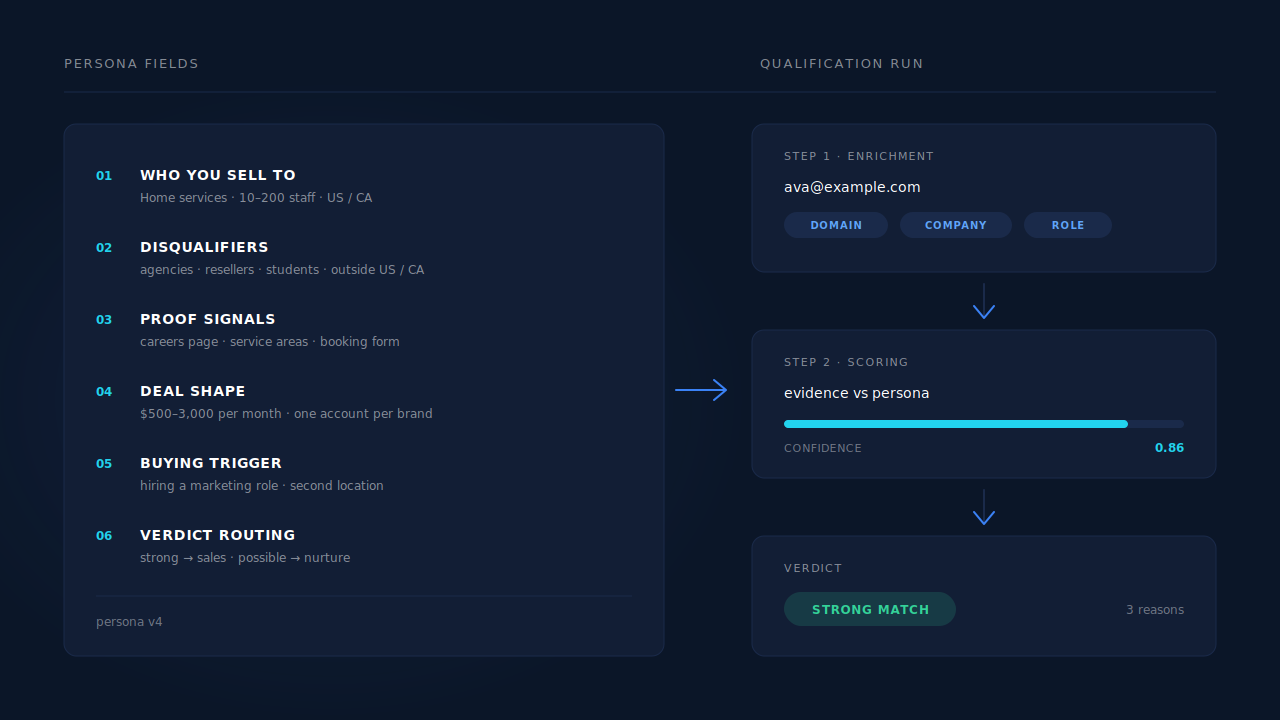
1. Who you sell to, in attributes a stranger could check
Industry, company size band, role or seniority, geography, and business model. The test is whether someone with only a work email address and a search engine could confirm or refute it. “Companies that value craftsmanship” fails the test. “Home services businesses, 10–200 employees, US and Canada, selling to consumers” passes.
2. What disqualifies a lead outright
The single highest-leverage field, and the one almost always missing. Competitors, agencies pitching you, students and job seekers, companies below your minimum size, industries you cannot legally serve, regions you do not ship to. Each disqualifier is a rule the model can use to say no, and a lead list only becomes useful once things can be pushed to the bottom of it.
3. The evidence that counts as proof of fit
Tell the model what to look for, because otherwise it weights whatever it happens to find. Useful proof is public and durable: a careers page hiring for the role that implies your product, a published pricing page, a physical location count, a funding announcement, a specific technology on the site. Naming your proof signals also makes the verdicts auditable — you can check whether the reason given is a signal you asked for.
4. The deal shape you want
Typical contract value, whether you want monthly or annual, one-site or multi-location, self-serve or sales-assisted. A lead can match your industry perfectly and still be worth declining because the deal that follows is a tenth of your average. Without this field, the model has no way to distinguish the two.
5. The buying trigger
What has usually just happened to someone right before they become a customer. New store launch, a hire on the paid media team, a site rebuild, a funding round, a jump from one location to three. Triggers are the part of a persona most teams know from experience and never write down, and they are frequently visible in exactly the public sources the enrichment step reads.
6. What each verdict should cause
Strong match goes to a human today. Possible match goes into a nurture sequence. Unlikely match stays in the database and out of the queue. Insufficient data gets one cheap manual look. Writing the routing into the persona forces a decision most teams avoid — it turns the verdict into an instruction rather than a decoration on a lead record.
How do you write a persona a model can act on?
Write it the way you would brief a new sales hire on their first day, then delete every sentence that could not be checked from the outside.
A weak persona reads like positioning copy:
Our ideal customer is an ambitious, growth-minded business owner
who values marketing and wants to scale.
A working persona reads like a filter:
Home services businesses (HVAC, plumbing, roofing, electrical),
10-200 employees, US or Canada, spending on Google or Meta ads.
Proof: a careers page, more than one service area page, a booking form.
Disqualify: marketing agencies, SEO freelancers, franchises above
500 staff, lead resellers, students, and anyone outside US/CA.
Deal shape: $500-$3,000 per month, monthly, one account per brand.
Trigger: hiring a marketing role, or launching a second location.
Routing: strong match to sales today; possible to nurture;
unlikely stays in the database.
The second one is not longer because it is more detailed. It is longer because it says no to things.
Two habits keep it working. Write in the vocabulary the public web uses — job titles as they appear on a careers page, industries as companies describe themselves — because the enrichment step is matching text it found against text you wrote. And change one field at a time when tuning, or you will never know which edit moved the verdicts.
What should you leave out of a persona?
Anything no amount of public research could establish. Budget as it exists in someone’s head, urgency, whether they liked your ad, personality traits, “readiness to buy”. Asking a model to assess these produces a confident-sounding guess, and a guess in the reasons field is worse than an “insufficient data” verdict because it looks like evidence.
Leave out protected characteristics entirely. Do not write personas that target or exclude by race, religion, gender, age, disability or similar attributes — that is a compliance problem in most jurisdictions, and it is not what fit means anyway.
Leave out your own internal jargon. Tier-2 accounts, the ICP-B segment and the blue-box motion mean nothing to a model reading a stranger’s website.
And leave out behaviour. Page views, session counts and email opens belong in your engagement data, not your fit definition — mixing them means an enthusiastic bad-fit lead outranks a quiet perfect one. Keep the two measurements separate, then use both: fit decides who gets called, engagement decides the order within the strong matches.
How do you tell whether your persona is working?
Read the reasons, not the verdicts. Pull twenty recently scored leads, hide the verdict column, and have whoever runs sales mark each one good-fit or not. Then compare. Disagreements point at a missing field, and the reason text usually names it — a model that justifies a strong match with “the company has a website and appears active” is telling you your proof signals are empty.
Three failure patterns are worth recognising:
- Everything is a possible match. No disqualifiers, or bounds too wide. Add the exclusion list first.
- Everything is unlikely. The persona describes your best customer rather than your ordinary one, or it stacks conditions that rarely co-occur. Loosen one bound at a time.
- Verdicts are right but nobody acts on them. The routing field is missing, so the verdict lands on a record instead of in a queue.
Re-check after any real change in what you sell, and after a source shift — a new channel often brings a different population, and a persona tuned on search traffic can misread a social audience entirely. When a source starts producing strong matches at a different rate from the rest, that is also a signal worth carrying into which attribution channel to scale.
How does PartialLeads qualify leads against your persona?
You write the persona once in your settings. From then on, qualification runs in two steps per lead. The first step is enrichment: a search-capable model researches the lead’s email domain and the person behind it against the live web. The second step scores that evidence against your persona and returns a verdict — strong match, possible match, unlikely match or insufficient data — with a confidence score and the reasons behind it.
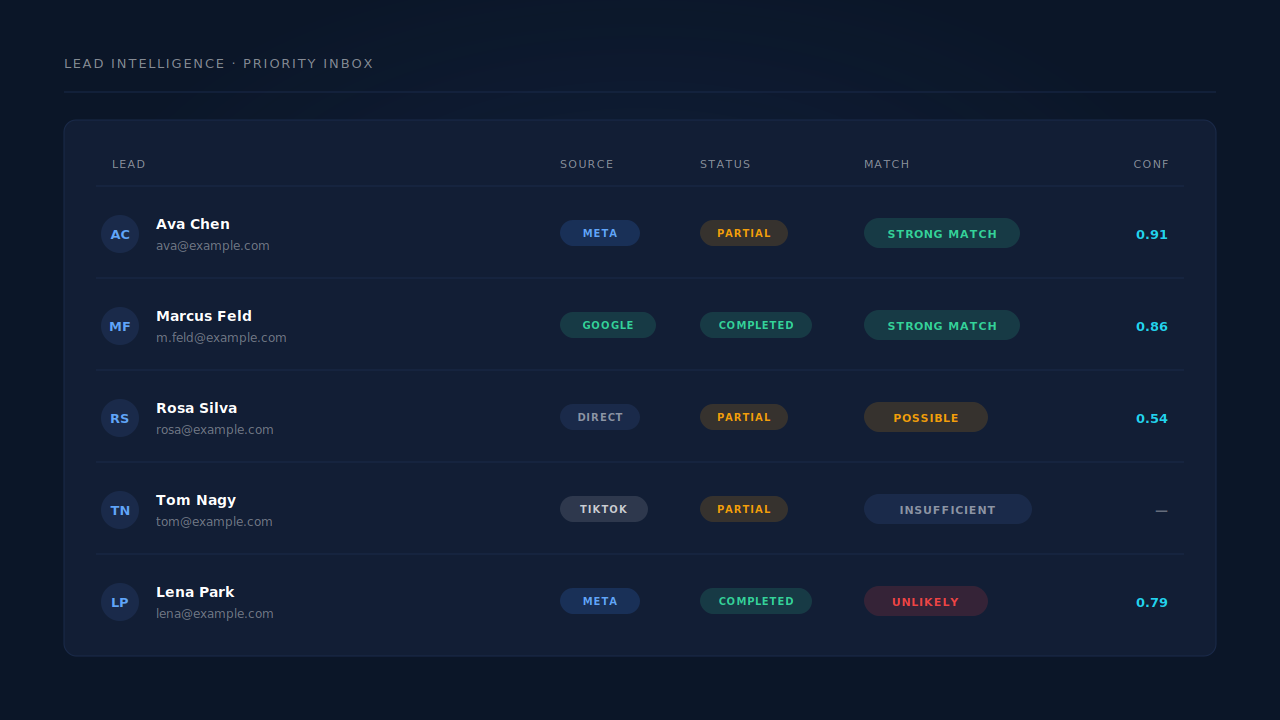
The verdict is not a number floating on a record. The lead’s Customer Match card shows the verdict with a confidence ring and the reasoning, and strong matches surface in a priority inbox above the lead table, which is the routing field from your persona made real.
The part that changes what a persona is worth: qualification does not wait for a submit. Because partial lead capture records the email and phone as they are typed, someone who filled in their work email and then abandoned the form is still a partial lead with an email address — so they get enriched and scored like anyone else. The people your form loses are exactly the ones nobody has ever qualified.
Enrichment results are cached per email and persona version, so re-opening a lead does not burn a credit, and editing the persona produces a fresh evaluation rather than a stale one. Accounts start with 25 free credits, with monthly allotments on paid plans.
Honest constraints, because they decide whether this works for you. A consumer email address with no public footprint will return insufficient data — that is the correct answer, not a failure, and a persona built on firmographics will produce a lot of them on a B2C list. The verdict measures fit against what the web can show, so a genuinely stealthy company reads thin. And if you want to ask questions across the scored population rather than read cards one at a time, you can connect Claude or ChatGPT to your lead data and query it directly.
| What breaks | The mechanism | Where you see it in the dashboard |
|---|---|---|
| Every lead scores “possible match” | Disqualifiers and proof signals in the persona give the scoring step grounds to reject a lead | Match verdicts with their reasons on the Lead Intelligence card |
| Nobody trusts the score, so nobody uses it | Every verdict ships with a confidence score and written reasons, not a bare number | Customer Match card, confidence ring and reason list |
| Sales works the newest lead instead of the best one | Strong matches are surfaced above the lead table | Lead Intelligence priority inbox |
| Your best-fit visitor abandoned the form, so they were never qualified | Email and phone captured before submit, so partial leads enter qualification like completed ones | Leads list: a Partial badge with a match verdict beside it |
| A thin lead gets a confident-sounding guess | Insufficient data is a real verdict when public evidence is absent | The verdict itself, with the reasons that were and were not found |